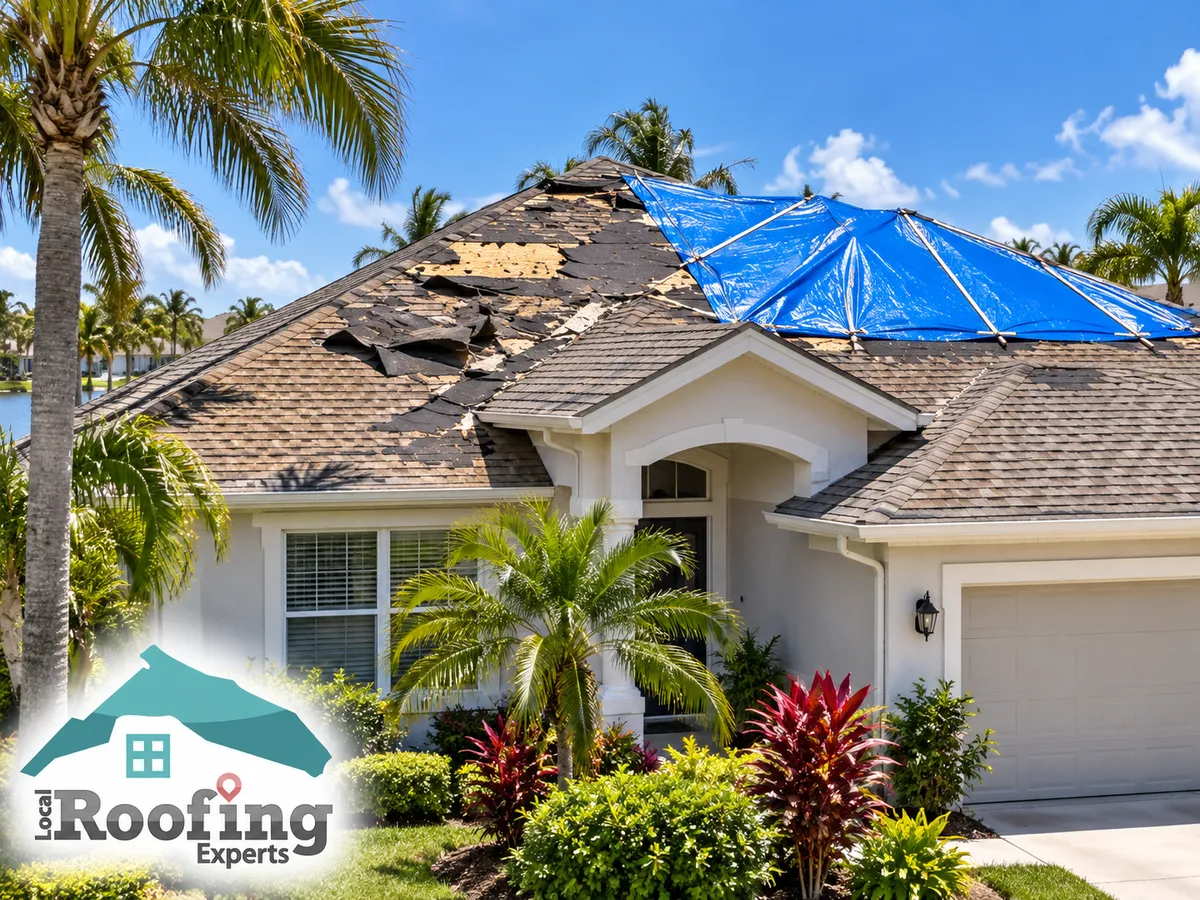
Emergency Roof Repairs After a Storm: What Florida Policies Pay for the Tarp (Brevard County Guide)
Emergency Roof Repairs After a Storm: What Florida Policies Pay for the Tarp (Brevard County Guide)
September 10 is the statistical peak of the Atlantic hurricane season. NOAA's August 6 update calls for a below-normal 2026 season (7 to 13 named storms, 2 to 6 hurricanes, 0 to 2 major), and as of September 9 the National Hurricane Center shows nothing forming in the next seven days. That makes this the right week to read the one section of a Florida homeowners policy that decides who pays for the tarp.
One thing first. We are a roofing contractor, not a public adjuster. Florida Statute 489.147(2)(d) bars a contractor from interpreting policy provisions or advising an insured on coverages or duties under a property policy. Everything below is quoted or summarized from public sources: the Florida Department of Financial Services, Citizens Property Insurance, the Florida Statutes, and a published appellate opinion. Confirm your own coverage with your carrier, your agent, or a licensed public adjuster.
What the state says the contract requires
The Department of Financial Services' storm FAQ states: "You are required by your insurance contract to make temporary repairs to prevent further damage. The adjuster must see the damage to evaluate your loss. Take pictures of the damage and keep all receipts for materials purchased for emergency repairs."
The Homeowner Claims Bill of Rights (Florida Statute 627.7142) says the same thing in its advice list: make and document emergency repairs necessary to prevent further damage, keep the damaged property if feasible, keep all receipts, and photograph or video the damage before and after any repairs. The same list advises contacting the carrier before entering any repair contract, to confirm managed-repair provisions or preferred vendors. Carriers must deliver the Bill of Rights within 14 days of the first claim contact, except for events under a Governor's state-of-emergency declaration, which is common for named storms.
Citizens' own after-a-loss page lists "placing a tarp on a damaged roof" as an example of an emergency repair, and adds that the adjuster must inspect and authorize any permanent tear-out, removal, or repair before it is completed.
The pattern across all three sources: report the loss, protect the property without waiting for the inspection, and leave the permanent work until the carrier has looked.
Where the dollar limit lives
Florida policies reimburse this work under an Additional Coverage that Citizens and many private carriers title Reasonable Emergency Measures (the ISO form calls it Reasonable Repairs). The limit is not uniform. Citizens publishes coverage worksheets for its own forms and for private carriers that take out Citizens policies. Three of them show the range. The worksheets state they are informational only and not an interpretation of the policy.
Citizens HO-3, worksheet dated 11/25.A separate 2 percent of Coverage A limit applies to temporary protective roof coverings. A $3,000 limit applies to water discharge from plumbing, HVAC, appliances, or sprinklers. The worksheet does not state a limit for other emergency measures or describe an approval mechanism. Citizens' October 2, 2025 agent bulletin confirms the roof-covering limit was introduced for policies effective December 1, 2025, and that the coverage "requires prompt notice of loss." On a Rockledge home insured for $350,000, the roof-covering limit is $7,000.
Security First HO-3, worksheet dated 01/24.The greater of 1 percent of Coverage A or $3,000. The limit can be increased with company approval, or if the company fails to respond within 48 hours of the insured's request, up to the cost actually incurred for necessary emergency measures. Same $350,000 home: $3,500, unless the homeowner asks for more and either gets approval or gets silence for 48 hours.
TypTap HO-3, worksheet dated 12/23.The greater of $3,000 or 1 percent of Coverage A, with no increase mechanism shown.
Two base numbers, one increase mechanism, and a 2x spread on the same house. Citizens prints a version of its limit on the declarations page; the bulletin says that statement was amended to express the temporary roof covering requirement. On most private forms the number is only in the Additional Coverages section of the policy. Ten minutes this week to find it is time well spent.
The $4,238.75 lesson from a Citizens case
InAll Insurance Restoration Services, Inc. v. Citizens Property Insurance Corp., 328 So. 3d 1057 (Fla. 3d DCA 2021), a restoration company holding an assignment of benefits did emergency water mitigation on a Citizens-insured home, then emailed Citizens an invoice for $7,238.75. Citizens paid $3,000, the operative figure under that policy's limit of the greater of $3,000 or 1 percent of Coverage A, and paid nothing further.
That policy let the insured exceed the limit by requesting approval, with Citizens obligated to respond within 48 hours. The Third District Court of Appeal held that an invoice for completed work is a demand for payment, not a request for authorization. Citizens owed $3,000.
Translated to a roof: on a form with an approval mechanism, the request has to reach the carrier before the work. Put it in writing and attach the estimate so you can prove what you asked and when. After the fact, the cap is the cap.
The 72-hour line, and who still has it
The Security First and TypTap worksheets say permanent repairs made without company authorization are not covered, with two exceptions: reasonable emergency measures, and permanent repairs that begin after the earlier of 72 hours from reporting the loss, the loss inspection, or other approval.
Citizens removed the 72-hour repair restriction from its HO-3, HO-6, and DP-3 forms for policies effective December 1, 2025. Its current worksheet lists only the emergency-measures exception, and its after-a-loss guidance still says the adjuster must inspect and authorize permanent work first.
Either way, a crew that wants to strip and re-deck the roof before the carrier has inspected or authorized the work, or before any 72-hour window on your form has run, is asking you to risk paying for it yourself.
Why you are now the one holding the receipt
Before 2023, a roofer could tarp a house, take an assignment of benefits, and bill the carrier directly. Florida Statute 627.7152(13) ended that for any residential property policy issued on or after January 1, 2023; an attempted assignment on those policies is void. A direction-to-pay is not an assignment and remains lawful, but the claim stays yours.
Practically: you pay the tarp contractor, you submit the receipt, and the carrier applies the limit. None of the worksheets say how the hurricane deductible interacts with this reimbursement. Ask your carrier that question before the storm, not after.
Documentation the sources agree on
Photograph and video the damage before any work, and photograph the tarp after. Keep every receipt. Citizens' guidance is to copy the original receipt, keep the copy, and give the original to the adjuster, who "will review the receipts and determine coverage for reimbursement under your policy." Citizens' December 2025 forms require the insured to retain damaged property unless Citizens gives written permission to discard it, which is stricter than the Bill of Rights' "if feasible."
Two additions from our side of the ladder. Ask for an itemized receipt showing labor and materials rather than a lump sum; an adjuster can price a line item. And ask the crew for a short written statement of what was installed and why it was needed to stop further damage. Our storm damage repair crews in Brevard Count put both in the paperwork on every emergency call.
The tarp can close your 10-day cancellation window
One more statute worth knowing this week. Florida Statute 489.147(6) gives a homeowner 10 days to cancel a roof repair or replacement contract signed within 180 days of a Governor's state-of-emergency declaration, without penalty, or until the "official start date," whichever comes first. The statute defines official start date to include the day "a temporary repair to the roof covering or roof has been made in compliance with the Florida Building Code."
So if the same company that tarps your roof also has you sign a full replacement contract at the door, the tarp itself can end your right to cancel. Sign the emergency tarp order and the replacement contract separately, and read the 14-point cancellation notice the statute requires above your signature.
Brevard specifics
Coverage A on beachside homes in Satellite Beach, Cocoa Beach, and Indialantic is high enough that a 2 percent limit is real money. On older mainland homes in Cocoa, Titusville, and west Melbourne, a $3,000 floor is the whole emergency budget on the forms above, and on a steep or complex roof one tarp visit will run past it. Which case you are in is decided by the form you hold, not by the storm.
The deadline on the other side of the claim does not move. Florida Statute 627.70132 requires notice of the claim to the carrier within one year of the date of loss (18 months for a supplemental claim). Nothing in the statute pauses that clock while you make emergency repairs or wait on an invoice.
Do this before the next advisory
Pull your policy PDF and search for "Reasonable Emergency Measures" or "Reasonable Repairs." Write down the limit and whether there is a 48-hour approval mechanism. Put your carrier's claims number and your policy number in your phone. Then decide now who tarps your roof, because after a storm licensed crews book up fast and door-knockers frequently are not licensed. Florida Statute 489.147 bars a contractor from offering to waive your deductible, or anything else of value, in exchange for a roof inspection or a roof claim, and knowingly waiving a deductible to defraud a carrier is felony insurance fraud. Verify any roofer at MyFloridaLicense.com before signing. Our license is CCC1335645 and our reviews from Brevard homeowners are public.
This post is general information, not legal or insurance advice. Policy forms differ by carrier and edition; the figures above come from coverage worksheets published on Citizens' website as of September 9, 2026. Confirm your own limit with your policy, your agent, or your carrier.
Local Roofing Experts provides emergency tarping, storm damage roof repair, and full replacement across Rockledge, Cocoa, Merritt Island, Titusville, Melbourne, and Brevard County. We photograph before and after, itemize every invoice, and put the mitigation statement in writing. If the storm gets here first, call(321) 487-5424 or request a roof inspection online. Repair costs above your emergency limit can be spread out through our roof financing options, and common claim questions are answered on our roofing FAQ. Florida licensed roofing contractor #CCC1335645. Learn more about Local Roofing Experts.