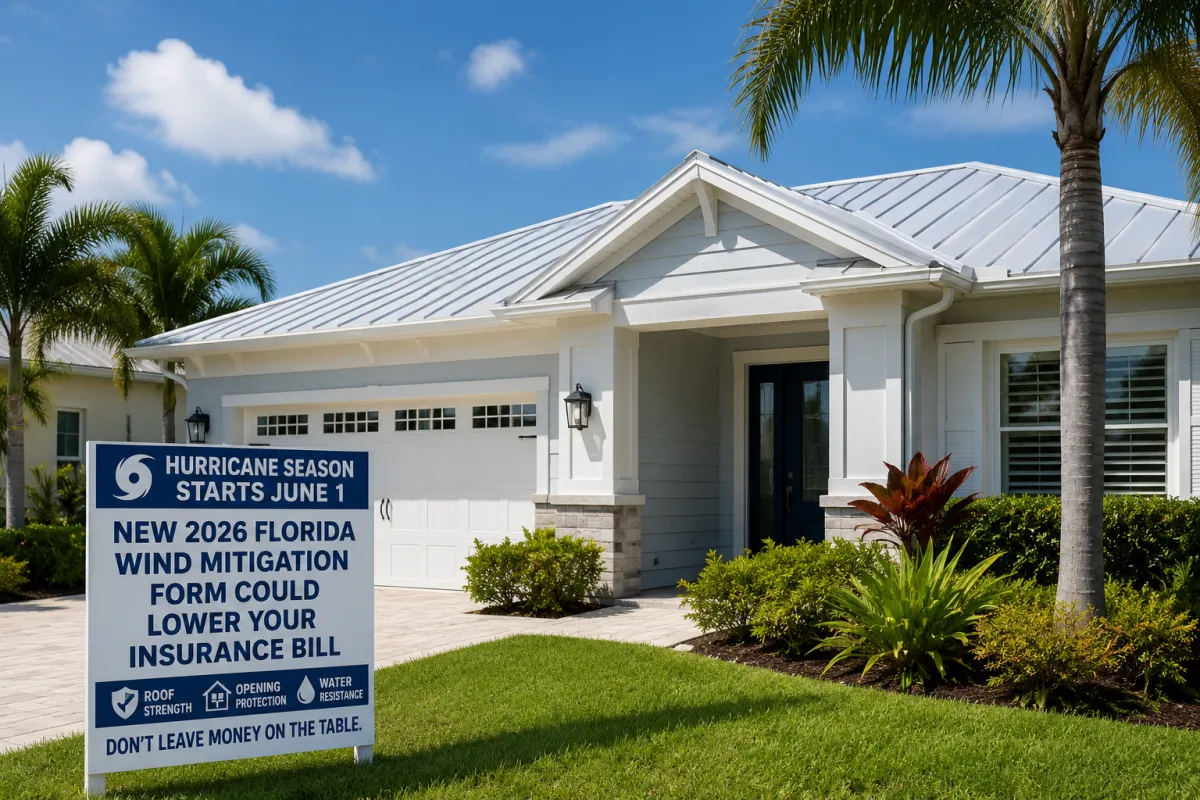
Brevard County Homeowners: The New 2026 Florida Wind Mitigation Form Could Cut Your Insurance Bill. Here's What to Do Before June 1.
Brevard County Homeowners: The New 2026 Florida Wind Mitigation Form Could Cut Your Insurance Bill. Here's What to Do Before June 1.
Hurricane season starts June 1. If you live in Brevard County, that gives you about a week and a half to make one phone call that could pay for itself many times over. The state of Florida updated its wind mitigation inspection form on April 1, 2026, and most homeowners in Rockledge, Cocoa, Merritt Island, Titusville, and Melbourne have not heard about it yet.
Here is the short version: Florida law requires every insurance carrier to give you a discount for verified wind-resistant features on your home. Your roof is the biggest piece of that puzzle. A wind mitigation inspection puts those features on paper in a format every Florida insurer is required to honor. The new form reflects updated research on what actually keeps a roof attached to a house during a hurricane, and the credits on the new form line up with that research.
If you have never had a wind mitigation inspection done, or if your last one is more than five years old, the next two weeks are the right window to act.
What a Wind Mitigation Inspection Actually Does
A wind mitigation inspection is a one-time, roof-focused walkthrough that documents how your home is built to resist hurricane-force wind. The inspector fills out the Uniform Mitigation Verification Inspection Form (the OIR-B1-1802), and you hand that form to your insurance carrier. Florida Statute 627.0629 requires the carrier to apply credits for every wind-resistant feature the form verifies.
The inspection itself is not expensive. Most Florida inspectors charge somewhere in the range of $100 to $200 for the inspection and the completed form. The form is valid for up to five years as long as you do not change anything structural on the home.
Inspectors look at five categories that matter most for the wind portion of your premium:
Roof Covering. Is it shingle, metal, or tile, and does it meet current Florida Building Code?
Roof deck attachment. What size and length nails were used to attach the plywood deck to the trusses, and how closely are they spaced? An 8d nail at 6 inches scores significantly better than a 6d nail at 12 inches.
Roof-to-wall attachment. Are the trusses or rafters held down by toe nails, clips, single wraps, or double wraps? Each rung up the ladder gets you a bigger credit.
Secondary water resistance. Is there a peel-and-stick membrane under your roof covering? It is a yes-or-no question on the form, and the yes answer can be worth real money.
Opening protection.This covers windows, doors, and skylights, not the roof itself, but it gets folded into the same form.
If your home already has good answers in those five categories, the inspection captures them. If it does not, the inspection report becomes a roadmap for which upgrades will pay you back fastest.
What Changed on April 1, 2026
The Florida Office of Insurance Regulation adopted an updated version of the OIR-B1-1802 form effective April 1, 2026. The update was driven by a 2024 residential wind-loss mitigation study that re-examined which construction features actually reduce damage in real-world storms.
The headline changes for homeowners:
The list of construction details that qualify for credits was refreshed to match what the study found.
Carriers are transitioning to the new form through the summer of 2026. Many insurers will begin applying credits under the new form in July.
Inspections completed on the old form remain valid for the five-year window, but new inspections from April forward use the new form.
Practically speaking, if your last wind mitigation inspection is from 2021 or earlier, it has expired. If it is from 2022 or 2023, you may still benefit from a fresh inspection on the new form before your renewal date this year, especially if you have done any roofing or window work since the original inspection.
How the Math Plays Out for a Brevard Homeowner
The wind portion of your homeowners policy is the biggest line item on most Brevard County premiums. Industry references put typical wind mitigation savings in the 25 to 45 percent range on that portion of the policy. The credits stack, so a home with strong answers across all five categories can see even larger reductions on the windstorm portion of the policy.
The inspection costs roughly $100 to $200. If your annual wind premium is $2,000 (a conservative figure for many homes in Brevard's coastal zip codes) and you capture a 25 percent credit, you have paid for the inspection in the first year and kept the savings for the next four. That is the floor, not the ceiling.
We are not making promises about your specific savings here. Every carrier rates differently, and your home's features are what they are. The point is that the math almost always works in the homeowner's favor when the inspection turns up credits that were not previously on file.
What Brevard Homeowners Should Do This Month
Hurricane season is two weeks out. Here is a sequence that works:
Step 1: Find your current insurance declarations page. Look at the wind premium line. That is your baseline.
Step 2: Check whether you already have a wind mitigation form on file. Call your agent or pull the form from your insurer's customer portal. If you have one, check the date. Anything five years or older is expired.
Step 3: Get the new inspection done. A licensed Florida home inspector, general contractor, or engineer can perform the inspection. Schedule it before hurricane season hits, because availability tightens fast once we are into June.
Step 4: Submit the completed form to your carrier. The credits are not automatic. Your agent has to apply them. Ask for a revised declarations page showing the new wind premium.
Step 5: If the inspection turns up weak categories, fix them. Strapping a roof, adding secondary water resistance, or replacing an older roof with a code-compliant system can all swing your form answers into higher credit tiers. Some of those upgrades may also qualify for the My Safe Florida Home grant program, which is currently active in 2026 for qualifying single-family homes.
Where Your Roof Fits In
Three of the five form categories are roof items. That is not an accident. The roof is where almost every hurricane-related insurance claim originates, and it is where almost every meaningful wind mitigation credit lives.
If your roof is more than 12 years old, was installed before the 2007 Florida Building Code overhaul, or has been patched repeatedly, the wind mitigation form is going to surface that. The good news is that a code-compliant replacement done correctly almost always produces strong form answers, and the resulting insurance savings can offset a meaningful portion of the replacement cost over time. The grant program can offset more.
If you have any doubt about what an inspector is going to find when they crawl your attic and look at your nailing pattern, a pre-inspection roof assessment is the smart starting point. We do those for Brevard County homeowners as a standalone service, and the assessment doubles as a baseline for any future repair or replacement decision.
Two Weeks Out
The homeowners who come out of hurricane season in the best shape every year are the ones who took action in May. The new wind mitigation form gives you a specific, concrete action with a clear financial payoff. It is not the kind of thing that gets easier to deal with after a storm.
If you want a Brevard County roofer to look at your roof before the first named storm of the season, give Local Roofing Experts a call at (321) 487-5424or reach out through our contact page. We serve Rockledge, Cocoa, Merritt Island, Titusville, Melbourne, and the rest of Brevard. Licensed and insured, license #CCC1335645.